Every AI is a student, and the library is running low. For years, bigger models meant bigger piles of human writing: web pages, books, code, forum arguments. Now a new kind of material is quietly filling the shelves: text, images and experiences that no person wrote, photographed or lived, produced by algorithms on purpose. It is called synthetic data, and it already sits inside many of the AI tools you use. THE LIBRARY IS RUNNING LOW The internet feels endless, but the part worth learning from is not. Researchers at Epoch AI estimate that the world’s stock of useful public human text is on the order of 300 trillion tokens, and that AI developers could use essentially all of it somewhere between 2026 and 2032 if current trends continue. Meanwhile, the web is filling with machine-written text, and gathering fresh human examples, such as labelled images or expert answers, is slow and costly.
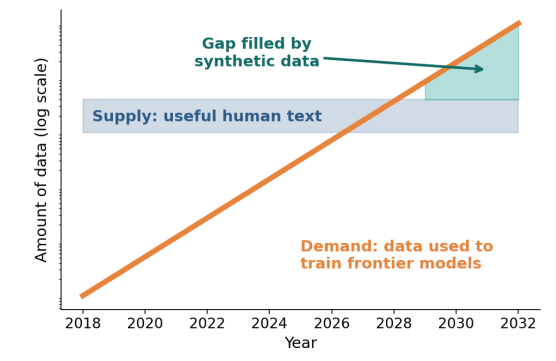
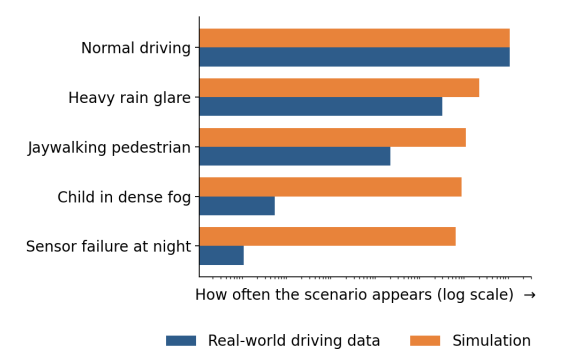
When the shelves run short, you start printing your own books. Demand for training data grows far faster than the supply of useful human text. Synthetic data fills the gap (illustrative trend). WHAT “SYNTHETIC” REALLY MEANS Synthetic data is information generated by a program instead of collected from the world, built to share the statistical patterns of the real thing. It comes in four main flavours: text such as questions, answers and code; images and video that are rendered or generated; tables of realistic but invented records; and simulated experience, where a robot or a car practises in a virtual world. “Synthetic” does not mean fake and useless. A flight simulator is not a real flight, yet pilots learn from one every week. PRACTICE FOR THE ROAD NOT TAKEN A self-driving car must know what to do when a child steps out of dense fog. That almost never happens in real footage, and nobody wants to wait for it. In simulation it can happen a million times before lunch. Waymo says its driver has covered billions of miles in virtual worlds, with scenes built from real road data and then bent into rare, dangerous variations. Robots learn to grasp, walk and balance the same way: thousands of virtual attempts for every one in the lab. Rare events barely appear in real driving data. Simulation can make them as common as everyday driving (illustrative values).
TEACHERS, STUDENTS AND ANSWER KEYS B Y T H E N U M B E R S Language models now help train one another. A strong “teacher” model writes thousands of questions, worked solutions and sample conversations, and a smaller “student” learns from them. This idea sits behind techniques such as self-instruct and distillation, and behind Microsoft’s Phi models, which leaned heavily on synthetic “textbook-style” material. It works best where answers can be checked. Code can be run against tests. A maths result can be verified. So the pipeline generates thousands of attempts, keeps only the ones that pass, and trains on the survivors. The answer key does the quality control. “Synthetic data works when something checks it. Without a checker, it is a machine agreeing with itself.” WHEN THE REAL THING IS PRIVATE Hospitals and banks hold rich data they cannot freely share. Synthetic patient records, such as those made by the open-source Synthea project, let researchers build and test tools without exposing a single real person. Fraud teams do something similar: genuine fraud is a tiny slice of all transactions, so invented examples help balance the lessons. Privacy is not automatic, though. A careless generator can memorise and leak its source material, so good teams test for exactly that.
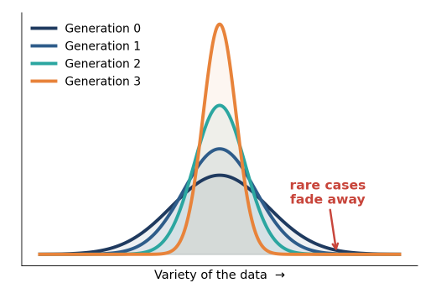
THE PHOTOCOPY PROBLEM Copy a photocopy enough times and the picture turns to mush. Models can suffer the same fate. A 2024 study in Nature showed that models trained again and again on their own output gradually lose the rare, unusual cases and drift toward bland averages, a failure called model collapse. Synthetic data can also inherit a generator’s bias, or look convincing while being subtly wrong. Each generation trained on the last one forgets more of the rare “tails” of the data (illustrative). 300T tokens: Epoch AI’s estimate of the useful public human text available for training 2026–32 window in which Epoch AI projects that stock could be fully used up 2030 Billions year by which Gartner expects synthetic data to overshadow real data in AI models of miles driven in simulation by Waymo’s virtual fleet A RECIPE THAT WORKS Teams that use synthetic data well tend to share five habits. They anchor it in real data instead of replacing it. They verify with tests, checkers and simulators. They keep it diverse, varying topics, styles and difficulty. They use a stronger teacher or a better process, never blind self-feeding. And they measure every gain on held-out real data. The synthetic data loop: generate, verify, filter, blend with real data, train, then test on real data (illustration). FROM COLLECTING TO DESIGNING For years, AI progress meant gathering more data. Increasingly it means designing it: choosing what to generate, how to check it and how to blend it with the real world. Gartner has estimated that by 2030 synthetic data will overshadow real data in AI models. Human knowledge stays the foundation that keeps models honest. Synthetic data is the multiplier built on top of it. T R Y I T Y O U R S E L F In a terminal, type pip install faker. Then in Python run from faker import Faker followed by print(Faker().name()). Each run invents a person who does not exist: one tiny piece of synthetic data. Now imagine millions of rows, checked and blended with real ones. So when an AI answers a question nobody ever taught it, remember: it may have learned from a world that never existed. Synthetic data is the fuel, and engineers are learning how to refine it
Comments
Join the discussionNo comments yet. Be the first to comment.